Last updated: July 19, 2026
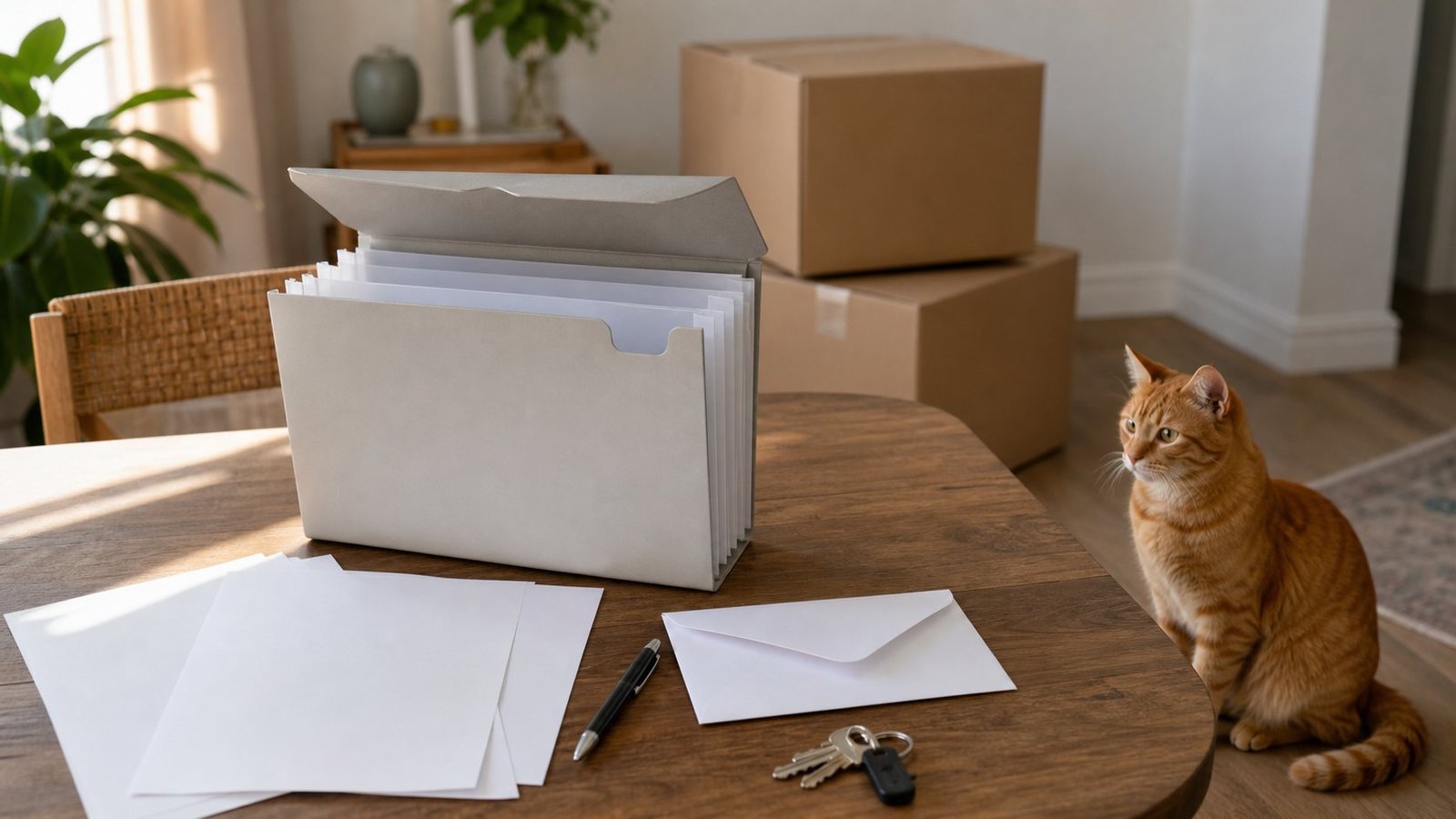
A moving documents folder checklist solves a small but expensive-in-time problem: the record you need is often inside a sealed box. Instead of packing every paper together, build one carry-with-you folder for the move itself, one secure reference set, and a simple trail of confirmations you can check after arrival.
Use the moving documents folder checklist as a working control sheet, not as another place to store papers indefinitely.
This is an independent organization guide, not legal, financial, or government advice. Agencies, landlords, carriers, and service providers set their own requirements. State and local rules vary, so confirm what applies where you are moving.
Decide what the folder is for
Your moving documents folder checklist is not a complete household archive. It is the set of records you may need between the last night at the old address and the first few days at the new one. Think “access and proof,” not “everything we own.”
Use three destinations while sorting:
- Carry: records needed during travel, key handoffs, account calls, or the first days in the new home.
- Secure separately: irreplaceable originals and sensitive records that are not needed in transit. Choose storage appropriate to your circumstances rather than leaving them in an unattended vehicle or an openly labeled moving box.
- Discard safely: outdated duplicates that contain personal information. Do not put sensitive paperwork loose in recycling or trash.
Ready.gov says access to personal financial, insurance, medical, and other records can be crucial after an emergency and recommends gathering critical personal and household information. That disaster-preparedness advice supports a practical moving rule: know where important records are, but carry only what the move requires.
Moving documents folder checklist: build it in four passes
Pass 1: identify the move and the people
- A copy of the moving or rental agreement pages you may need for arrival, plus the relevant contact details.
- Travel details, access instructions, and the agreed key pickup or handover arrangement.
- A household contact sheet that works if a phone battery dies. Include only details that are genuinely useful.
- Any identification or proof specifically requested by the property manager, mover, carrier, or service provider.
Do not assume a lease copy or one form of ID will satisfy every organization. Ask the recipient what it accepts, and avoid carrying additional originals “just in case.” Requirements can differ by provider and location.
Pass 2: capture the old-home closeout
- Move-out inspection appointment and instructions.
- Dated condition photos stored in a clearly named phone or cloud folder, if taking them is permitted and useful.
- Key, access-card, or parking-pass return instructions.
- Utility stop or transfer confirmations and any final meter information you were authorized to record.
- Moving-company inventory or receipt supplied for your job.
Keep this pass focused on evidence you can match to an action. Our utility transfer checklist explains how to pair request dates with final and first bills instead of treating the confirmation screen as the end of the task.
Pass 3: prepare the new-home handoff
- New-address format as confirmed by the property or relevant authority.
- Arrival window, key collection details, and a reachable contact for access problems.
- Service start confirmations, account reference numbers, and installation appointments.
- Any building-specific move-in reservation, elevator, parking, or access record.
- A short list of urgent address updates still outstanding.
USAGov directs movers to update the Postal Service and points to separate federal and state services for taxes, Social Security, veterans benefits, immigration, motor vehicles, and voter registration. A postal change does not update those organizations for you. Use the site’s broader change of address checklist to decide which notifications belong on your follow-up list.
Pass 4: create a confirmation index
A useful moving documents folder checklist needs one plain index page at the front. For each action, record:
- organization or provider;
- request submitted date;
- effective or appointment date;
- confirmation or reference number;
- where the receipt, email, or screenshot is stored;
- the date you will verify completion.
A reference number without context is easy to lose. Naming a screenshot “water-start-new-address-July” is more useful than leaving it among hundreds of camera images. Keep account passwords out of the paper index.
Keep the digital copy from becoming the weak copy
A scanned companion to your moving documents folder checklist can help when paper is unavailable, but it also concentrates personal information. The Federal Trade Commission recommends keeping software current, using strong passwords, and turning on two-factor authentication for online accounts. Apply those basics to the account or storage location that holds your moving records.
- Scan only records you have a reason to keep.
- Use a private, access-controlled location rather than a public link.
- Check that the files actually open before relying on them.
- Do not email a bundle of sensitive documents to yourself merely for convenience.
- Share a record only with the organization that requested it, through a channel you independently verified.
Delete unnecessary working copies from shared devices, printers, and download folders after confirming the retained version is usable.
Run a two-minute departure check
Use this moving documents folder checklist before the door closes:
- Open the folder and find the arrival details without searching.
- Confirm the old-home key return and new-home key collection plans.
- Open at least one important digital backup from the device you will carry.
- Check that the folder is in your personal bag—not a box going into the moving truck.
- Make sure no passwords, full payment-card details, or unnecessary identity records are on the front index.
If you arranged forwarding, keep its confirmation with the same move records and use the USPS mail forwarding checklist to verify the separate postal step.
Close the folder after arrival
Do not file the folder away on day one. Give each entry a completion check:
- Test that utilities and any scheduled services are active as expected.
- Confirm returned keys or access items were acknowledged when an acknowledgment is available.
- Match the moving receipt and any inventory to what was delivered.
- Watch for the first bill or statement showing the correct service address.
- Verify high-priority address changes directly with each organization rather than assuming mail forwarding proves the account was updated.
Once the open items are complete, move lasting records to your normal secure filing system and dispose of temporary duplicates appropriately. The folder has done its job when every confirmation points to a verified result—not when it is merely full.