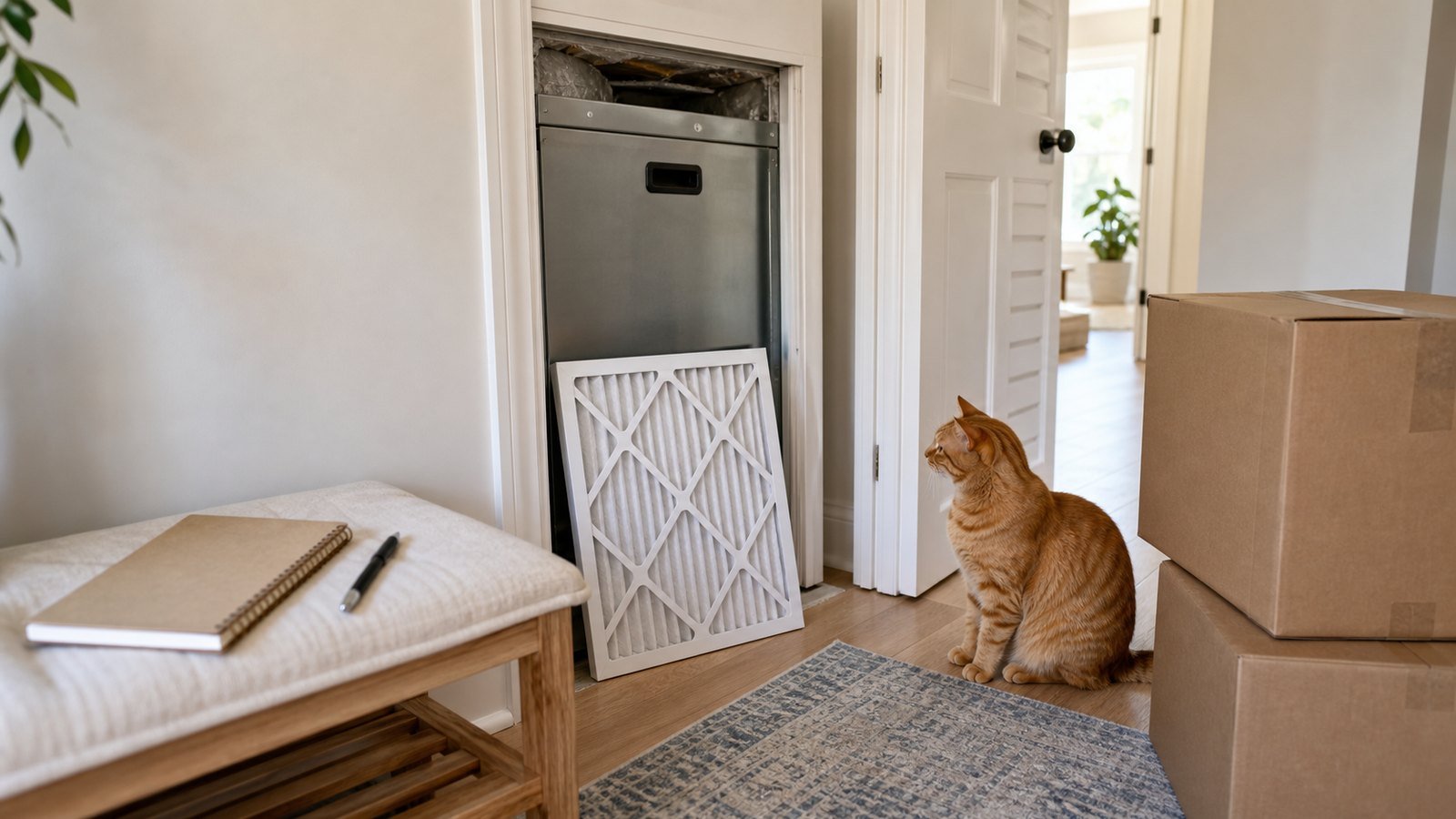
A new home air filter checklist helps you identify the filter already serving the home, record what fits, and leave yourself a reliable replacement trail. Do this before buying a multipack or copying a schedule from another house. Filter location, size, type, access, and responsibility can differ by system, building, lease, and manufacturer.
Start with the system, not the store shelf
Begin with the equipment off and only inspect an ordinary, accessible filter slot or return grille. Do not remove a screwed panel, reach near wiring or moving parts, climb into an attic or crawlspace, or assume every grille contains a filter. If the location is unclear, use the manual, equipment label, move-in papers, property portal, or the person responsible for the system.
- ☐ Ask whether the home has one central filter, more than one return filter, or a different setup.
- ☐ Confirm whether a landlord, building team, homeowner, or service company supplies and changes it.
- ☐ Photograph the closed access point from far enough away to recognize the room.
- ☐ Note any safe access issue, such as a high ceiling grille or blocked utility door, before moving furniture into place.
- ☐ Keep pets and loose packing material away while the access point is open.
This new home air filter checklist is narrower than the site’s new home energy checklist. That page records controls, comfort patterns, and the first utility baseline. Here, the task is to identify one service item correctly, preserve its details, and verify the next change.
Build your new home air filter checklist record
When the filter can be viewed safely, save what is printed on the existing frame or stated in the official manual. Photograph the full filter and each useful label before disposal, but avoid capturing keys, mail, account screens, or family information. Do not rely on a handwritten size alone if the slot, manual, and filter frame disagree.
| Record | What to save |
|---|---|
| Location | Room and access point, such as “hall return grille” |
| Count | Number of filters you actually confirmed |
| Dimensions | The full size shown on the frame or approved instructions |
| Type or rating | Exact wording from the filter or system guidance |
| Orientation | A photo of how the existing filter sits before removal |
| Responsibility | Who supplies it and which request or purchase route applies |
| Date | Inspection or change date, plus the next check reminder |
Add the equipment make, model, and manual link to your separate appliance records if they are available without opening equipment. Keeping system details outside the filter reminder means you can replace a receipt or calendar entry without rebuilding the whole home file.
Choose a compatible replacement
The U.S. Environmental Protection Agency explains that furnace and HVAC filters work only when the system operates. EPA also advises choosing a filter rated at least MERV 13—or as high as the system fan and filter slot can accommodate—and notes that a professional HVAC technician may be needed to determine what works with a particular system. Treat compatibility as a system question, not a contest for the largest number on a package.
- ☐ Match all listed dimensions; do not force, trim, stack, or improvise a filter.
- ☐ Compare the approved type or efficiency information with the manual or property instructions.
- ☐ If you cannot verify compatibility, photograph the existing filter and ask the responsible property contact or qualified technician.
- ☐ Keep the receipt or order confirmation until fit and approval are settled.
- ☐ Avoid promises that one filter will remove every indoor pollutant. EPA states that no air cleaner or filter eliminates all pollutants.
A useful new home air filter checklist records the answer you received and where it came from. “Same size as the old one” is not enough when the old filter may itself be wrong or when a managed building has a specific supply process.
Change only what you can access safely
Follow the system, filter, and property instructions for shutdown, removal, airflow direction, access closure, and restart. Keep the old filter contained while carrying it through the home. Do not vacuum, wash, or reuse a disposable filter unless its instructions explicitly allow that treatment.
Before closing the access point, check that the replacement sits flat without being crushed and that any orientation marking matches the documented airflow direction. Close the grille or ordinary access cover fully. If it will not close normally, stop rather than bending the filter or operating the system with an unsecured cover.
Set a reminder from evidence, not memory
ENERGY STAR’s heating and cooling maintenance checklist advises inspecting, cleaning, or changing central air-conditioner, furnace, and heat-pump filters once a month, and says a contractor can show you how. Use that as a check prompt—not a universal promise that every filter must be discarded monthly. The product instructions, system needs, occupancy, renovation dust, pets, season, and property agreement can change the appropriate action.
Put the first check date in your new home air filter checklist, then keep a short history: inspected, still usable under the instructions, cleaned if designed for it, replaced, or referred to the property contact. Save a photo of the installed filter only if it can be taken safely after the access point is closed.
Verify after the first change
- ☐ Confirm the access cover is closed and the surrounding area is clear.
- ☐ Keep the package details, receipt, and change date together.
- ☐ Listen and look from outside the closed equipment area for anything clearly abnormal after normal operation resumes.
- ☐ If the system does not start, the cover will not close, the filter moves out of place, or you notice a new unusual sound or odor, turn back to the approved property or service route rather than troubleshooting inside equipment.
- ☐ Recheck the reminder after the first inspection cycle and adjust it to the documented instructions.
The new home air filter checklist is complete when the location, count, compatible specification, responsibility, change or check date, and proof are all recorded. If you also notice condensation or dampness near the system, keep that observation separate and use the new home moisture checklist rather than guessing that the filter caused it.
Official guidance used
Read the current ENERGY STAR heating and cooling maintenance checklist for the monthly inspection prompt and the EPA’s Guide to Air Cleaners in the Home for filter limits, replacement, system operation, and compatibility guidance.
Use this new home air filter checklist as an organization and follow-up tool, not as a repair manual, indoor-air diagnosis, or substitute for the equipment manufacturer, property instructions, or a qualified technician.