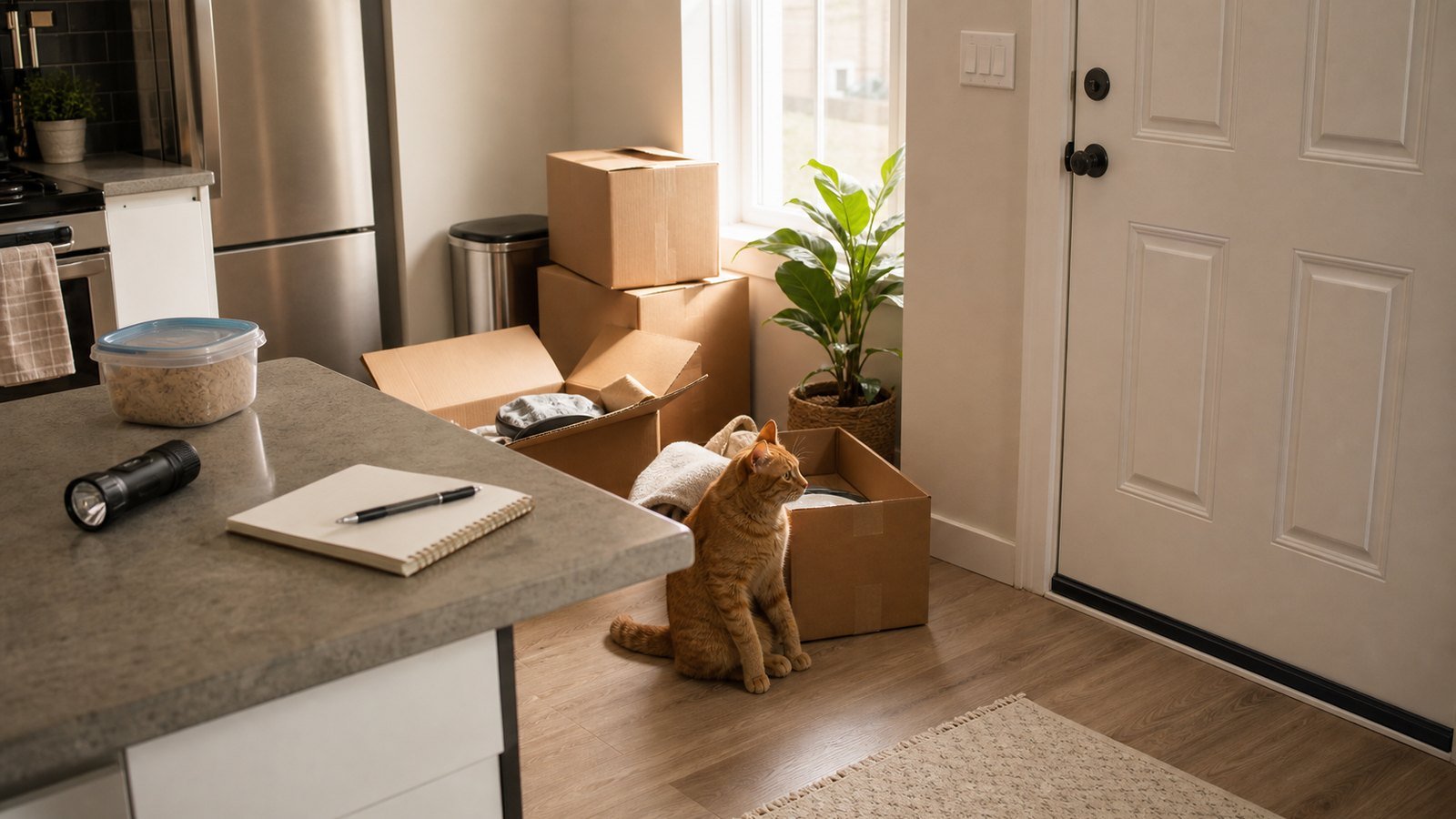
A new home pest prevention checklist is easiest to start while boxes are still being opened. You are not trying to diagnose every speck or choose a treatment. You are creating a dated baseline, removing routine food and water opportunities, and recording property gaps clearly enough for the right person to review.
First-evening reset
- ☐ Put opened food and pet food into closed storage.
- ☐ Flatten empty boxes only after checking them in good light.
- ☐ Close indoor waste and take it to the correct collection point.
- ☐ Dry ordinary spills and note any unresolved moisture source.
- ☐ Look at accessible door edges, screens, cabinets, and pipe openings.
- ☐ Start one private observation note instead of guessing at a species.
This is a prevention and recordkeeping pass, not a pesticide or repair guide. Lease terms, HOA rules, shared-building procedures, and local requirements vary. Do not move heavy appliances, open building equipment, handle an unknown product, or alter a part of the property without permission.
Prepare the new home pest prevention checklist
Keep the kit small: a flashlight, phone camera, blank note, sealable food containers, and the reporting route for the property. If you rent or live in managed housing, save the maintenance portal, office email, or other instructed contact method before you need it.
Choose one unpacking zone so cardboard, packing paper, and food do not spread through every room. Check the local collection arrangement with the trash and recycling setup checklist. A scheduled box-removal plan is more useful than shifting empty cartons from room to room.
Keep children and pets away from any unknown residue, bait station, trap, or service product left at the property. Do not touch or discard it merely to finish the checklist. Photograph its location from a safe distance and ask the responsible property contact what it is and how it should be handled.
Separate observation from identification
The EPA’s integrated pest management principles place monitoring, identification, prevention, and control in a sequence. EPA also notes that seeing a single pest does not always mean control is needed. For a move-in record, write only what you can support.
- Useful observation
- “One small insect seen inside the lower kitchen cabinet at 8:15 p.m.; photo saved.”
- Unsupported conclusion
- “The whole building is infested,” based on one unclear sighting.
- Useful property note
- “Daylight visible below the closed utility-room door; no alteration made.”
If you cannot identify what you saw, label it “unidentified” and keep the photo. Accurate location and timing are more useful than a confident name chosen from memory.
Walk the accessible edges before rooms fill up
Use the new home pest prevention checklist only where you can look safely. The aim is to note ordinary access and housekeeping issues, not to dismantle the home.
Entry, windows, and moving materials
- ☐ Close each accessible exterior door and look for an obvious visible gap without removing hardware.
- ☐ Check reachable window screens for a tear or loose edge.
- ☐ Inspect cartons as you empty them, then move unwanted cardboard to the approved collection area.
- ☐ Keep bags and boxes away from a damp area until the source is addressed.
Kitchen and food storage
- ☐ Transfer opened pantry food and pet food to closed storage.
- ☐ Wipe crumbs and ordinary spills from counters, shelves, and accessible floor edges.
- ☐ Check under the sink and around visible pipe openings without moving plumbing.
- ☐ Close waste and recycling containers according to the building or local setup.
Bathroom, laundry, and utility edges
- ☐ Dry routine surface water and hang damp towels where they can dry.
- ☐ Record continuing dampness or a leak through the appropriate route; use the new home water leak checklist for a separate water baseline.
- ☐ Look at accessible pipe and wall openings, but do not seal, spray, or reach into them.
- ☐ Leave locked, shared, electrical, or mechanical spaces to authorized staff.
Save a neutral observation record
A good new home pest prevention checklist record can be understood by someone who was not in the room. For each concern, keep the date and time, exact room and location, number observed, a plain description, one wide photo, one close photo when safe, and the action taken.
Crop out mail, account numbers, access codes, faces, and neighboring homes before sharing. If the issue was present at move-in, keep the note with your apartment move-in inspection record. Save the ticket number, portal confirmation, or email reply rather than relying on a verbal handoff.
Do not stage a photo by touching droppings, residues, a trap, or an unidentified animal. A clear location photo and a short written description are enough for an initial report.
Use prevention before reaching for a product
EPA describes prevention as a first line in integrated pest management and says monitoring and accurate identification help avoid unnecessary or incorrect pesticide use. In this checklist, prevention means ordinary housekeeping and authorized maintenance: closing food, managing waste, drying routine spills, reducing cardboard, and reporting visible gaps or unresolved moisture.
The new home pest prevention checklist does not recommend a spray, bait, trap, dose, or sealing material. If a product is already present, leave its label intact. Follow current label directions and property instructions, and keep pets and children out of any restricted area. Never combine products or use an unlabeled substance.
Verify the same locations
The new home pest prevention checklist is not complete after the first walk-through. Set one calm recheck after unpacking and again after any maintenance or service visit. Return to the same cabinet, doorway, screen, or utility edge. Record whether you saw nothing new, the same issue, or a changed pattern. “No observation during this check” is more precise than “problem solved.”
If a gap was repaired, photograph the finished area without testing it destructively. If housekeeping was the action, confirm that food, waste, cardboard, and routine water are still being managed. Keep the earlier and later notes together so the sequence remains clear.
When the pattern continues
Send the observation log through the correct property route and ask what follow-up applies. Avoid creating duplicate requests without referring to the first ticket. If the concern involves an unsafe area, damaged building system, unknown chemical, or an animal you should not approach, stop the routine check and use qualified assistance.
EPA’s service-selection guidance says many household pest issues can be addressed through sanitation and maintenance, while an extensive or difficult problem may require a pest-control company. EPA advises considering quality and competence rather than cost alone. Ask a prospective service what it identified, what work it proposes, whether the applicator or technician meets current state requirements, and what labels or instructions will be provided.
Do not assume a company, landlord, HOA, or resident has the same duties everywhere. Confirm the lease, building process, local rules, and current state licensing information that apply to the property.
Close out the new home pest prevention checklist
Finish the new home pest prevention checklist with a one-page summary: areas checked, routine prevention completed, observations saved, property gaps reported, confirmation received, and locations rechecked. Keep open items open. The useful result is a traceable move-in record—not a promise that no pest can appear.
Official sources
- U.S. EPA — Integrated Pest Management Principles
- U.S. EPA — Tips for Selecting a Pest Control Service
Life Admin Checklist is an independent informational site and is not affiliated with the EPA, a landlord, HOA, building manager, or pest-control provider. This page does not provide pesticide, medical, legal, or property-responsibility advice.